Vision of the Month – Art – L.S.Lowry
This month’s Vision of the Month in Art is L.S. Lowry’s whimsical, reflective and mysteriously spacious print, The Cart, taken from the 1953 painting.
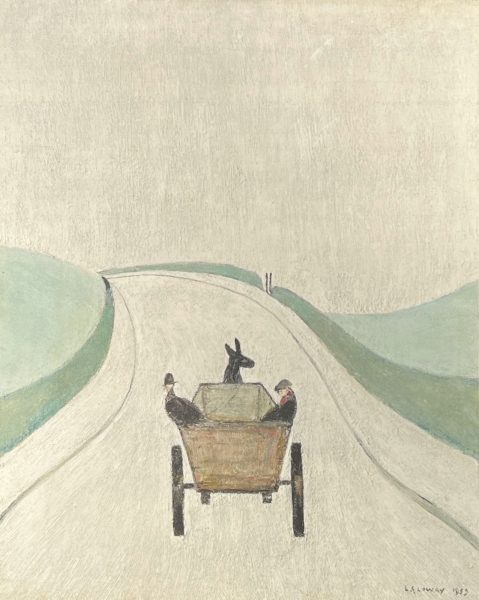
This has always been a favourite not-to-be-sold picture in our household, so when the opportunity came along to acquire another copy of this much-sought after work, the opportunity was quickly taken.
In 1929, Lowry painted The Hawker’s Cart, which depicted hawkers (usually antique dealers) or even what we once called Rag and Bone Men, traversing the streets of Salford either selling their wares or perhaps making a collection or delivery. I have always wondered if this was the same family 24 years later, on their way to collect something big out in the countryside or whether this is just one of Lowry’s rural scenes and nothing more. But what are the dark posts up ahead? Are the people in the cart townies or countrysiders? I have always thought that the figure on the left wearing a brimmed hat implied townie. But then the figure on the right wears a flat cap, which may imply countrysider. Where are they off to? The fields to collect the harvest? Or a house to pick up some furniture? Perhaps neither and they’re heading back to town having had a good day’s business in the country. So many unanswered questions.
What is inescapable is the beautiful, haunting emptiness of the scene and its surrounding landscape. A stillness, which is not often felt in Lowry’s work other than perhaps his seascapes.It’s a contemplative picture and truly my favourite print by Lowry.
I think I will leave the last word with my father who wrote about Lowry and landscape in his book, The Paintings of L.S.Lowry:
Landscape was one of the artist’s first passions. Long before he discovered the industrial scene, he was recording in pencil and in pastel country scenes from the environs of Lytham St Annes and Fylde. It is a passion to which he returned time and again for spiritual refreshment. Had he not discovered the industrial prospect there is little doubt that he would still have made his mark., but as a major painter of nature. In later years he has used lanscape, empty and bleak, as a foil to intensify his sense of the ultimate loneliness of man.